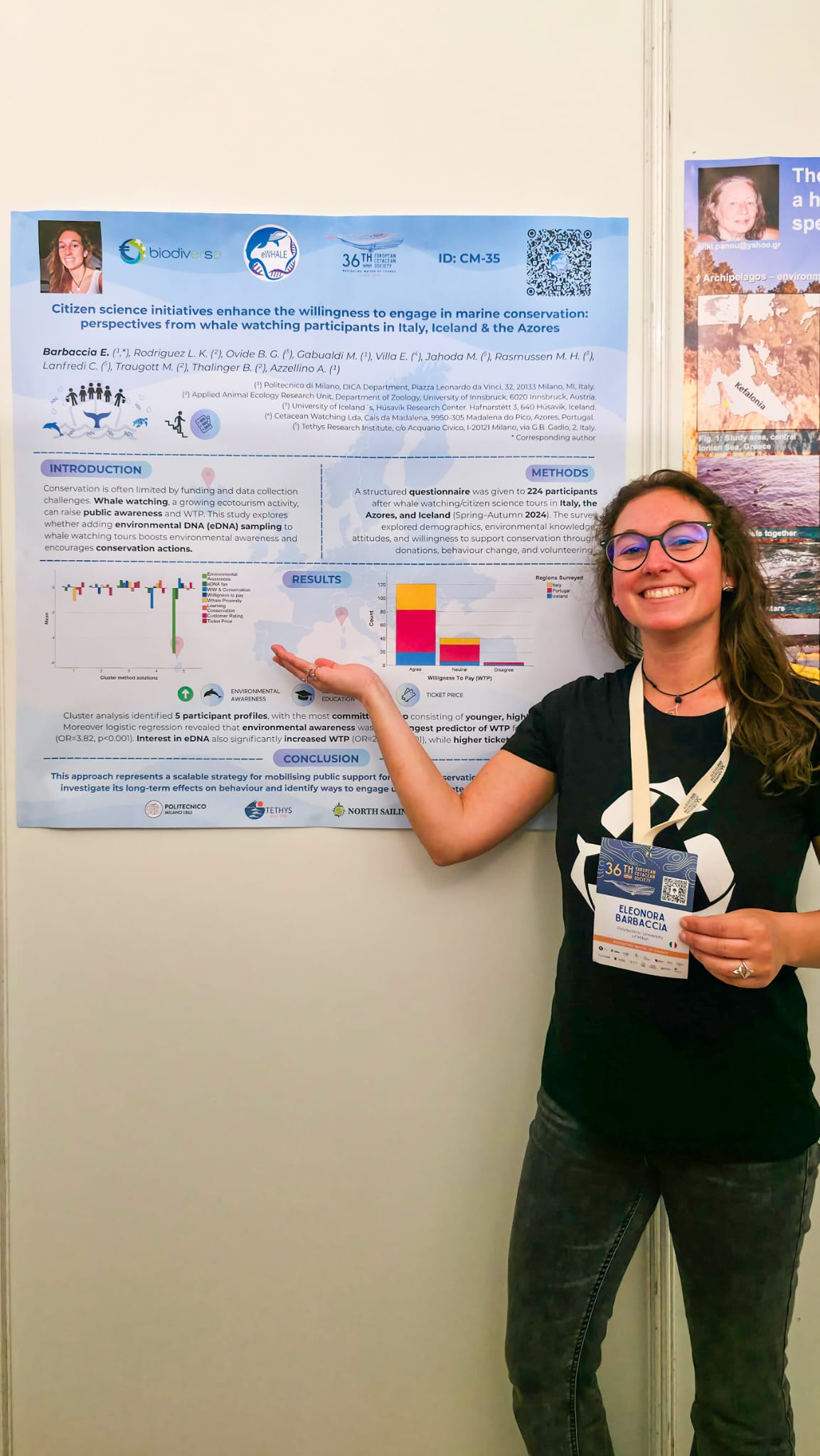
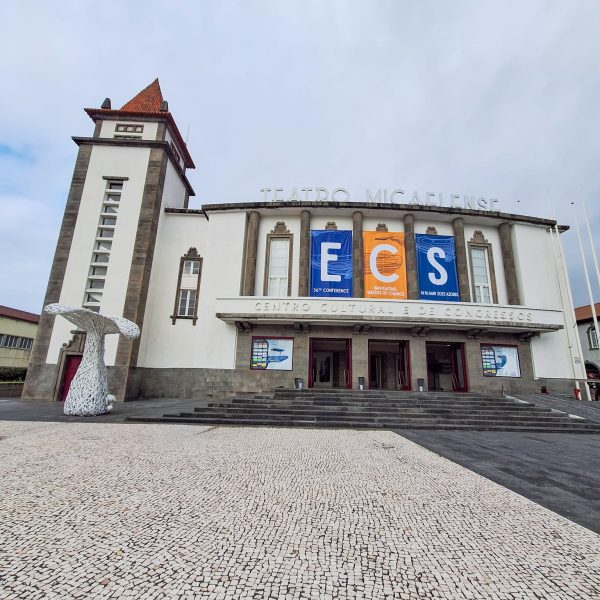
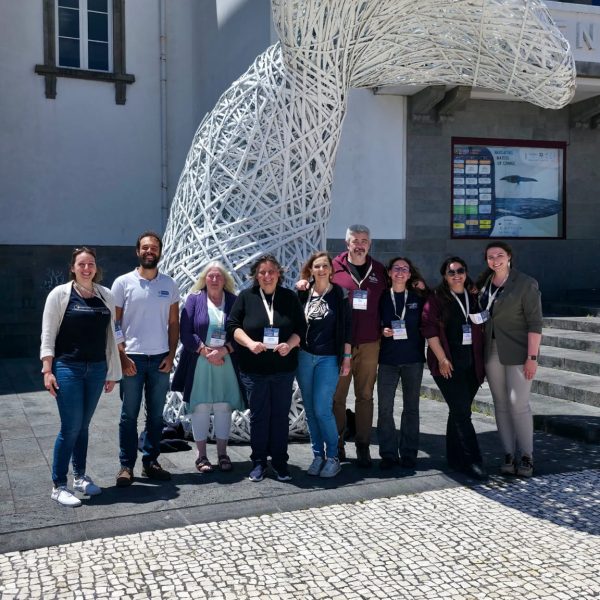
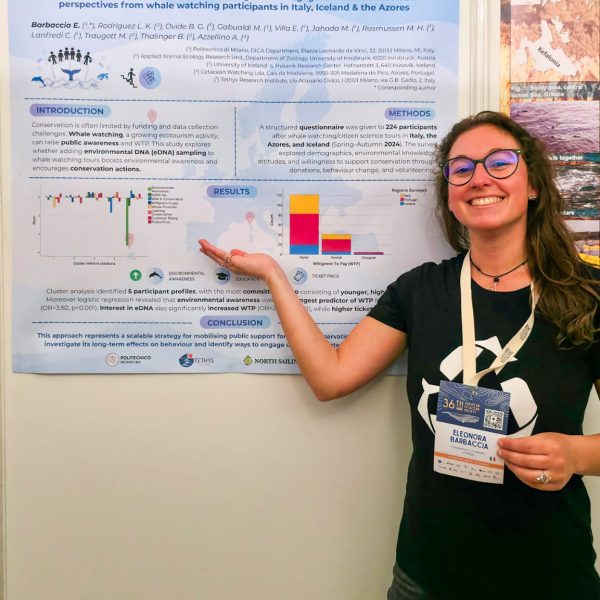
At ECS 2025, Eleonora Barbaccia presented the poster entitled “Citizen science initiatives enhance the willingness to engage in marine conservation: perspectives from whale-watching participants in Italy, Iceland and the Azores.”
We surveyed 224 participants during 2024 eWHALE campaigns across the Pelagos Sanctuary, Pico Island and Skjálfandi Bay, combining eDNA sampling with structured questionnaires to assess willingness to participate for conservation.
Factor and cluster analyses identified five participant profiles, with the most committed group being younger and highly educated; overall, about 80% expressed a positive willingness to contribute. Logistic regression indicated that environmental awareness and education predicted higher willingness to pay, while ticket price had a negative effect.
The study highlights whale watching as a powerful platform to build knowledge, mobilise public support and guide targeted outreach, with next steps focusing on behaviour change and engaging under-represented groups.
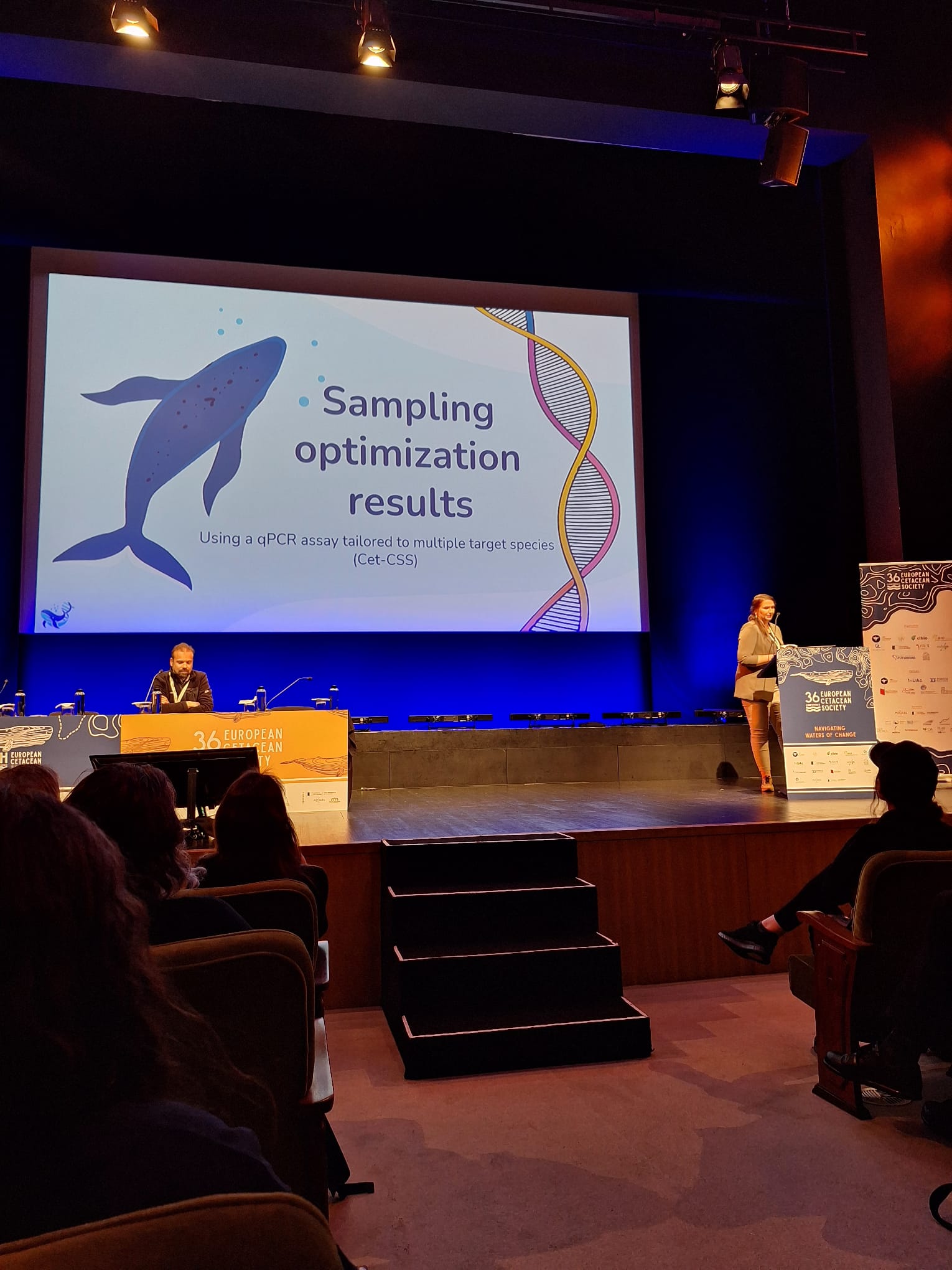
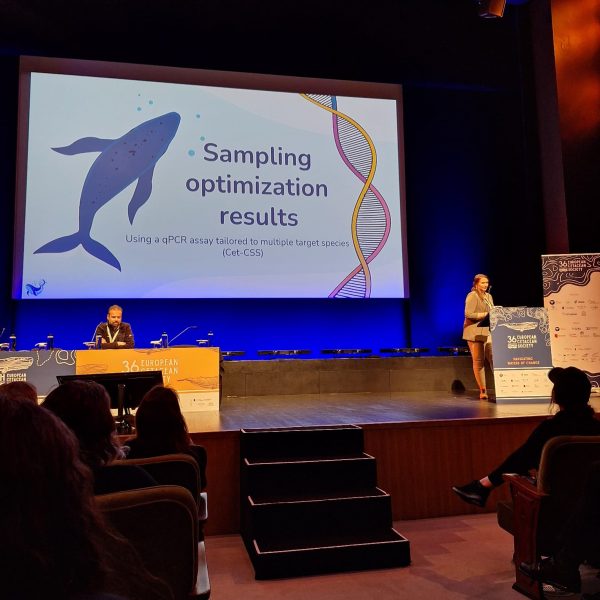
At ECS 2025, Lauren Rodriguez, the PhD student at University of Innsbruck (Asutria), delivered the talk “From fluke to food web: internationally optimised eDNA sampling protocol for whale-watching platforms reveals marine ecological networks in the Azores”.
She showed how harmonising protocols across three operators in the Atlantic and Mediterranean enables consistent, cost-effective monitoring: in 2023, 142 samples tested water volume (2–10 L), sampling timing (immediately to 20 min post-encounter) and filter pore size (three types).
Linear mixed models indicated that 10 L, immediate post-encounter sampling and 1.2 µm filters significantly improved detection probability and signal (p < 0.05). Applying the optimised protocol in 2024 (150 samples) around the Azores, metabarcoding captured cetaceans, their prey (e.g., small pelagic fish and krill), co-occurring vertebrates and key planktonic metazoans, revealing food-web structure and underscoring the potential of whale-watching operations for large-scale biodiversity monitoring to inform conservation.
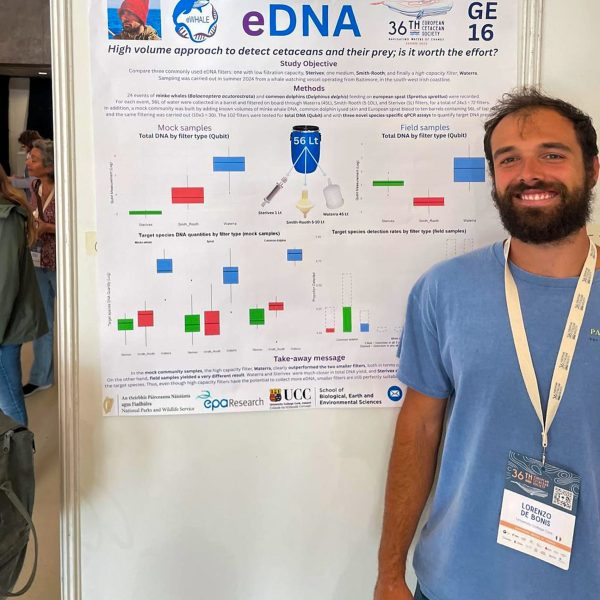
PhD student Lorenzo De Bonis (University College Cork, Ireland) joined the meeting with a poster asking a very practical question for anyone doing eDNA at sea: is it really worth going for high-volume filtration when sampling cetaceans and their prey from small and medium boats? To tackle this, Lorenzo compared three commonly used filter types – Sterivex (low volume), Smith-Rooth (medium volume) and Waterra (high volume) – during whale-watching cruises off Baltimore, on the south-west coast of Ireland. Across 24 feeding events of minke whales and common dolphins on European sprat, 56 litres of seawater were collected each time and split in parallel across the three filters, generating 72 field samples. An additional 30 filters came from controlled “mock community” barrels spiked with known amounts of DNA from the same species. All 102 filters are now being tested with species-specific qPCR assays, comparing not only detection rates and DNA yield, but also practical aspects such as filtration time, clogging, ease of use and inhibitor carry-over. The results will help the eDNA community understand when high-volume sampling really adds value, and when smaller, simpler filters may be just as effective.


 English